
How Long Does Video Production Take? A Realistic Timeline

One of the first questions clients ask — right after 'what does it cost?' — is 'how long will this take?' It's a fair question. While every project is different, the short answer is: a typical video production project at Soda City Films runs 4 to 8 weeks from kickoff to delivery. Here's what's happening inside that window. NOTE: this is just a general average for our company. We have some things that get done in a day, and some things that take months! (ok, continue)
Week 1–2: Pre-Production
Pre-production is everything that happens before anyone picks up a camera. This is where we figure out what the video is actually saying, who's in it, where we're shooting, and what the finished product needs to accomplish.
During pre-production we'll develop the creative concept (or work with our clients), write a script or interview framework, scout locations (sometimes), shot list/storyboard, schedule the production day, and handle any logistics, like permits, talent, or equipment rentals. This phase moves faster when a client comes in knowing what they want to say. It takes a little longer when the strategy needs to be built from scratch, which we can help with.
Every project is different, and each one requires different planning. For instance, events are typically a "what are we shooting" and when conversation, whereas a commercial requires all of the above, and sometimes more (sometimes less). There is no one-size-fits-all pre-production setup.
Day 1–2: Production
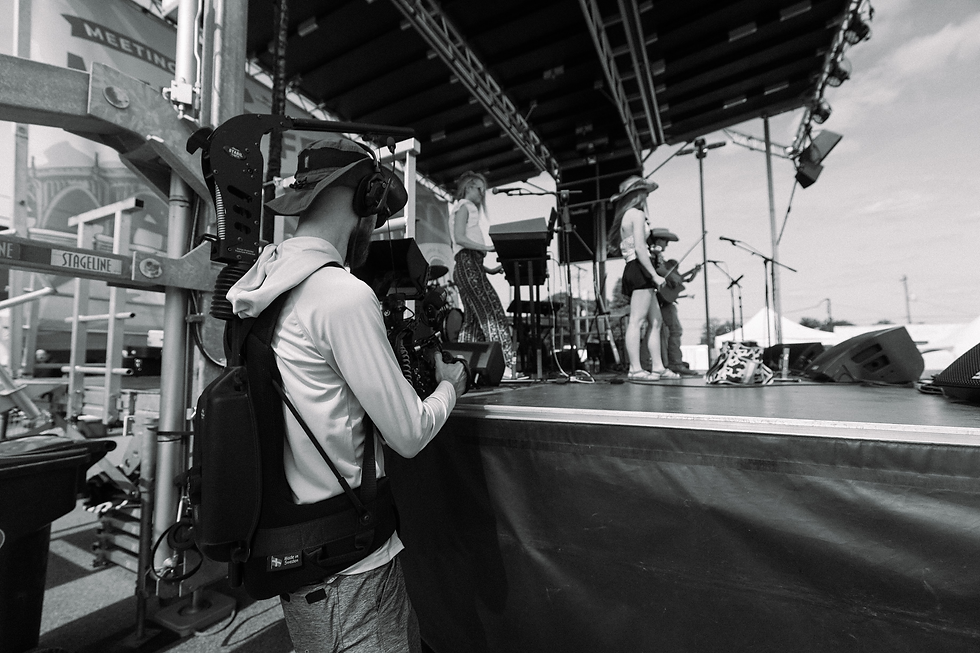
This is the shoot. Depending on the scope of the project, production might be a single half-day with one location and one subject, or it might be two full days across multiple locations with a larger crew. Either way, this is the part that feels like something is actually happening.
A well-run production day is a function of good pre-production. If the planning was thorough, the shoot is efficient and energizing. If the planning was rushed, the shoot may feel a little less efficient. We take pre-production seriously for exactly this reason.

We try our best to keep clients in the loop during the production process. We give them a monitor to see images being captured, a headset to communicate in quiet spaces (if necessary), and we involve them as much as they want to be involved in decision making. Again, this is all planned at this point, but things change, and we try to accomidate those changes when they happen.
We also take lunch very seriously, but that's a different topic.

Week 2–4: Post-Production
Post-production is where the footage becomes "the thing". This phase includes uploading and organizing footage, building the rough cut, adding music, color grading, sound design, motion graphics if needed, and delivering the first cut for client review.
We are proud to say that 90% of our projects go out the door without any requested revisions (w00t w00t), although getting notes isn't a big deal. Sometimes clients need to see "the thing" before they know exactly how to craft "the thing" the way they want it. In any case, we deliver your finished files in whatever format you need: TV, web, social, etc.
What Can Speed It Up (or Slow It Down)?
Projects move faster when the client has a clear brief, approvals happen quickly, and talent and locations are easy to coordinate. Projects slow down when feedback cycles stretch out, approvals require multiple stakeholders (lots of cooks in the kitchen), or scope changes mid-process. These are all production realities, and we've learned to roll with the punches. There will inevitably be a punch or two.
If you're working toward a hard deadline (a product launch, an event, a broadcast air date), tell us upfront. We'll build the timeline backward from your date and let you know immediately if it's doable. Are you thinking of making "the thing" finally? Reach out to Soda City Films today to see what it would take. #CommercialVideo #AdFilm #CommercialProduction #VideoAd #MarketingVideo

Comments